Semrush AI Visibility Toolkit: Track Your Brand in ChatGPT, Gemini & Google AI
Use Semrush Visibility Overview to compare brand mentions and cited pages across AI answers, then Prompt Tracking to monitor a small set of important buyer questions. Treat AI scores as visibility benchmarks, not traffic or sales.
What is Semrush AI Visibility Toolkit, and what can it tell you?
Semrush AI Visibility Toolkit helps you investigate how brands and websites appear inside AI-generated answers, rather than looking only at conventional Google rankings. Its Visibility Overview searches a large modeled set of questions, while Prompt Tracking repeatedly checks a smaller set of questions that matter to your business. This distinction matters: discovery can show where brands appear in a broad dataset, while monitoring follows your own chosen questions over time.
Use the toolkit if customers research your product category through ChatGPT, Google's AI search experiences or Gemini and you want to understand which brands are recommended, which websites are cited and what questions you currently miss. Do not treat the results as a complete transcript of every private chatbot conversation or as proof that people visited your website. Claim26 researched this guide using Semrush documentation; it has not operated a paid Semrush workspace or independently measured brand visibility.
Understand the difference between a mention, a citation and a click
A brand mention occurs when an AI answer names a business or product. A citation occurs when the answer references a particular domain or page as a supporting source. Your brand can be mentioned without a link to your domain, and your page can be cited without the answer explicitly recommending your brand. Semrush reports these signals separately in Visibility Overview and Prompt Tracking.
An AI recommendation is not automatically a qualified lead, and a citation is not an organic click. To assess business value, read the answer itself, inspect the cited URL and compare with referrals and conversions in your own analytics. Google Search Console reports Google Search visibility and clicks, not a full census of mentions across AI assistants. A practical reporting sheet should keep AI mentions, cited pages, search clicks, sessions and actual sales in separate columns.
Step 1 — Open Visibility Overview and choose the right brand
In Semrush's AI Visibility Toolkit, open Visibility Overview, enter your domain or brand and select the market and AI platform you want to investigate. Where the interface allows it, compare the brand against competitors serving the same audience. Semrush describes its Visibility Overview as a way to analyze a domain's presence in responses from ChatGPT, Google's AI experiences and Gemini, with daily-refresh data and platform-dependent coverage.
Start with one commercial category and one country or language. A French bookkeeping app and an English-language enterprise accounting suite may compete for different questions, so an unrestricted global benchmark can mislead. Keep the exact domain, selected AI platform, location, snapshot date and competitor set in your notes. The actual menu labels and available countries may change with plan and product updates. Official source: https://www.semrush.com/kb/1596-visibility-overview-report.
Step 2 — Read AI Visibility Score without mistaking it for traffic
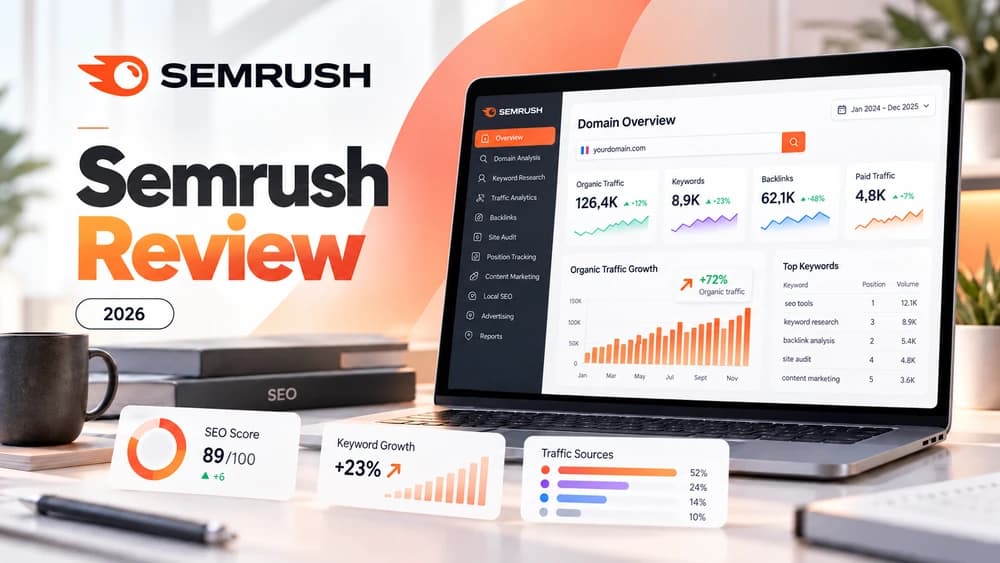
Semrush reports a normalized AI Visibility Score on a 0–100 scale. Its methodology combines topic coverage, meaning how many relevant topics contain the brand, and mention consistency, meaning how often the brand appears within those topics. A higher number therefore represents greater modeled presence in the monitored universe, not an 80% probability that every AI user will see your brand or a promise of extra website visits.
Also check Mentions, Monthly Audience estimates, citations and cited pages. The score and audience figures are derived from Semrush's datasets and modeling, not directly from your revenue records. If a score improves after a content edit, first inspect whether the monitored platform, location, topic set and sampling remain comparable. Treat a short-term swing as a signal for investigation rather than claiming the change caused a sale. Methodology: https://www.semrush.com/kb/1607-semrush-ai-visibility-data.
Step 3 — Find the questions where competitors appear without you
Scroll to Your Performing Topics and Topic Opportunities inside Visibility Overview. The first view identifies topics in which the brand is already mentioned. The opportunities view highlights questions where selected competitors appear but your brand does not. Sort and filter by potential audience, business relevance and competitor presence rather than pursuing every missing mention. A missing result for a low-value question is not necessarily a useful content opportunity.
For example, a hypothetical appointment-booking SaaS might appear for 'simple booking calendar' but be absent for 'appointment booking with payment reminders'. Investigate whether that capability really exists in the product, whether your site explains it clearly, and whether reputable external sources describe it correctly. Only then create or improve a page addressing the question. This is a fictional workflow illustrating an editorial decision, not a measured Semrush result or an endorsement by an AI platform.
Step 4 — Compare sources and cited pages, not just brand names
Use the Cited Sources, Source Opportunities and Cited Pages views to identify which domains and exact URLs AI responses reference. Semrush lets you inspect the full answer and distinguish your sources from other sources. A competitor's comparison page or an independent discussion may be cited more frequently than the vendor's landing page. That does not automatically make the independent source more accurate, but it tells you where a reader might encounter information that influences the answer.
Prioritize verifiable source gaps: missing product documentation, outdated pricing, unclear feature limits, unsupported claims or thin comparison pages. Publish original evidence, product details or tested explanations where justified; do not mass-produce pages by substituting competitor names into the same template. When a cited source is a third-party website, consider whether a legitimate correction or outreach is appropriate rather than assuming a paid link will increase AI visibility.
Step 5 — Configure Prompt Tracking around real buyer questions
Prompt Tracking is different from the broad discovery report: it monitors a defined list of prompts across supported AI search platforms over time. In Semrush, open Prompt Tracking, create a campaign for your domain, choose the available locations and platforms, and add a small set of meaningful customer questions. The official documentation lists ChatGPT Search, Google AI Mode and Gemini among monitored services; platform coverage, devices and country support can vary by feature.
Write prompts that reflect different purchase stages instead of repeating one question twenty ways. A booking-software company could track 'best appointment scheduling software for a small salon', 'which booking tool sends SMS reminders', and 'alternatives to [competitor] for payment collection' when those capabilities and audiences are real. Include a few branded questions and several non-branded alternatives. Preserve the exact prompt wording and location so you can review like-for-like results. Official reference: https://www.semrush.com/kb/1503-prompt-tracking.
Step 6 — Interpret visibility, position and source reports
Prompt Tracking reports how the tracked domain appears in AI responses, including visibility, average citation position and mentions, depending on the platform and report. Use the Overview and Sources views to see which competitor domains or third-party pages provide the evidence behind the answers. A high citation position in one monitored question is not a conventional Google ranking and cannot be extrapolated to every prompt.
Look at trends across several relevant prompts instead of averaging unrelated questions together. The Sources report shows which pages are cited and how many of the tracked prompts reference them. Compare AI results with traditional search in the available Devices & Locations reports when relevant. Semrush currently documents desktop-only AI search tracking and does not provide Estimated Traffic inside Prompt Tracking, so keep referral sessions in a separate analytics report.
Step 7 — Group prompts into useful topics and markets
Use tags to separate informational questions, product comparisons, pricing objections and high-intent purchase queries. Semrush also groups related prompts into topics. If you sell in different countries, do not assume that answers in France, the United States and Spain are equivalent; language, competitors and product availability may differ. Filter by the exact market supported by your subscription and document it in any report you share.
A monthly review might group ten questions about price, ten about specific features and five about alternatives, as an illustrative plan that fits a 25-prompt subscription. This is a proposed organization, not an experiment that Claim26 has run. Remove duplicates, avoid irrelevant vanity prompts, and leave room to test important new customer questions. Each prompt should help answer an actionable editorial or product question.
Step 8 — Turn a missing mention into an editorial improvement
First open the full AI response and identify what it actually says. Then ask whether your product genuinely satisfies the requirement. If it does not, a new blog article cannot honestly solve that deficiency. If it does, inspect your current documentation, feature page, pricing and comparison content. A useful correction might clarify an existing function, add concrete setup instructions or explain a limitation explicitly.
Build a simple action record: exact prompt, platform and country, named competitors, cited pages, factual gap, proposed change and review date. After publishing, recheck the same question and retain both observations. AI responses and Semrush's datasets can change for many reasons, so a different answer alone does not prove that your edit caused the shift. This process is designed to improve accuracy and usefulness even if no visibility increase follows.
An illustrative monthly AI visibility scorecard
Imagine a fictional SaaS website tracking 25 carefully chosen buyer prompts. Your scorecard could record that the brand appeared in 6 of those prompts, its site was cited in 3, and two competitor help pages repeatedly appeared for questions about integrations. Those numbers are invented for explanation, not current Semrush or Claim26 measurements, and should never be presented as actual traffic or a conversion rate.
The team would review the two source gaps, confirm whether its product supports the missing integrations, and improve one useful help page if justified. At the next check, it would compare the same prompt set and country, while separately reviewing Google Search Console clicks and analytics referrals. The decision to keep or discontinue the subscription depends on whether the reports lead to useful changes—not on raising a dashboard number without business impact.
Semrush AI Visibility Toolkit pricing and plan limits in 2026
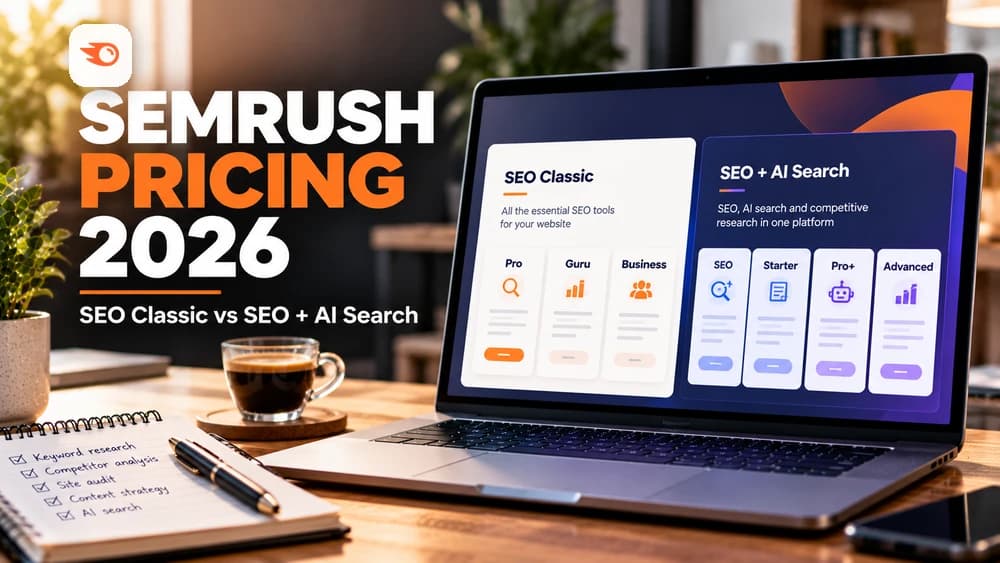
Semrush currently lists a standalone AI Visibility Base offer starting at $99 per month per domain when billed annually. The official AI pricing page describes 25 daily tracked custom prompts, one domain for Brand Performance and 300 visibility reports per day. This is a separate purchasing route from broader Semrush One or SEO + AI Search packages. Check the monthly-versus-annual billing switch and selected country before treating a listed figure as your final checkout price.
On the SEO + AI Search pricing page, Semrush also displays Starter at $199 per month and Pro+ at $299 per month when billed monthly, with indicative prompt allowances of 50 and 100 respectively. The Semrush One FAQ separately advertises starting pricing around $199.95 per month, reflecting overlapping product labels and offers. Do not assume every name refers to the same license, or that a free demo includes the full tracker. Compare the exact product name and included limits in your account before subscribing. Sources: https://www.semrush.com/pricing/ai/ and https://www.semrush.com/pricing/seo-ai-search/.
What the toolkit cannot measure or guarantee
Semrush relies on modeled prompt datasets and repeated observations of supported AI outputs. It does not see every private conversation in ChatGPT or Gemini, cannot guarantee your brand will be recommended for a future user's exact wording, and cannot directly attribute every brand mention to a click or sale. Broad AI topic volume estimates are not the same as keyword search volumes, and the reported audience is a directional estimate. Platform differences, regional settings and dataset updates all matter.
Do not infer that adding an llms.txt file, buying extra backlinks or writing more articles will automatically produce citations. Technical accessibility and trustworthy source content remain useful, but there is no guaranteed recipe for AI recommendations. Use your own verified lead and conversion reporting for the financial question; keep Search Console Web impressions and clicks separate from the AI visibility score. Reference: https://www.semrush.com/kb/1594-ai-seo-metrics.
Which Semrush tool should you use for which question?
Choose Visibility Overview when you want broad discovery of brand appearances and competitor topics. Choose Prompt Tracking when you have an explicit list of high-value questions and need daily comparisons. Use Semrush Site Audit when you need to diagnose crawling or technical issues, Keyword Research for conventional search demand and Position Tracking for organic rankings. AI visibility research complements these tools; it does not replace core SEO measurement.
If you only want an occasional exploratory look at a brand, check Semrush's current free demo and report allowances before purchasing. If you need sustained monitoring and can act on the findings, evaluate the AI Visibility Base plan or a bundle against the actual number of prompts, domains and users you need. Claim26 may earn an affiliate commission from qualifying Semrush subscriptions through its disclosed links at no additional cost to you; this guide does not claim that Semrush sponsors its editorial conclusions.
Checklist: your first Semrush AI visibility review
Write down your brand domain and country; choose two or three real competitors; examine the AI Visibility Overview; separate brand mentions from cited pages; identify commercially relevant missing topics; check the actual full answers and their sources; select a small set of buyer prompts; configure Prompt Tracking where your plan permits it; and keep the same settings for subsequent comparisons. Review the current limits before paying.
After the first snapshot, choose one concrete accuracy improvement rather than starting a batch of generic articles. Record what you changed and compare again on the same platform, prompts and location. Separately verify search clicks, referral sessions, conversions and revenue with their original data sources. A useful AI visibility report ends with an informed decision, not simply a colorful score. Semrush is a trademark of Semrush Inc.; this publication is independent.
Check these four signals.
✓Measure brand mentions separately from citations and clicks
✓Compare the same prompts, countries and platforms
✓Prioritize factually justified content gaps
✓Review plan limits before subscribing
The safest way to choose is to build a small real-world workflow.
Test the part of the customer journey that matters most before moving your entire system.
Official sources for this guide
Software pricing and features can change. Review the official documentation below before choosing a product or plan.