Semrush Backlink Gap: Find Competitor Backlink Prospects
Compare relevant competitor referring domains, read the gap filters and inspect each linking page before offering an editorial resource.
Backlink Gap serves a different purpose from Backlink Audit
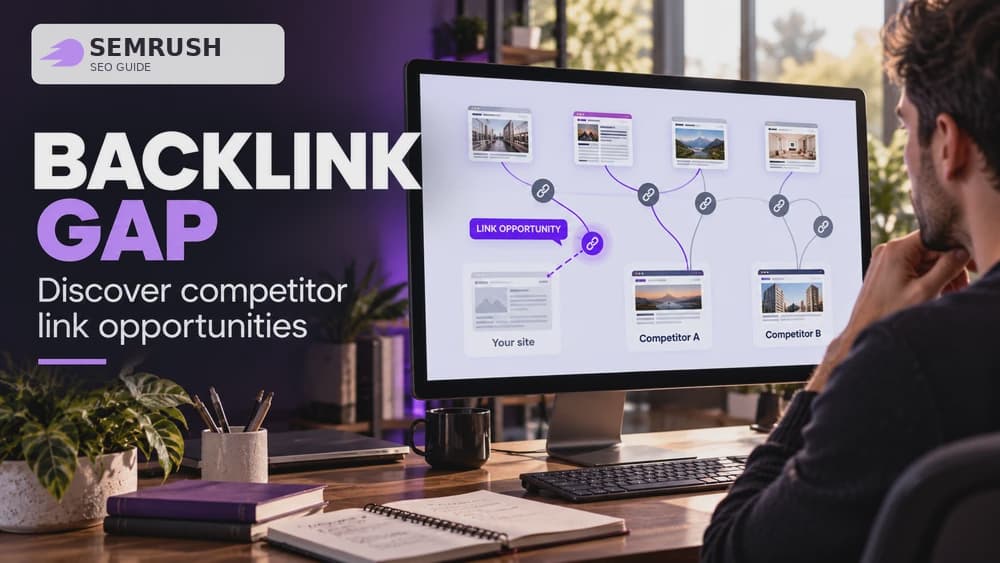
Semrush Backlink Gap finds referring domains that cite competing websites but do not yet link to yours. Its purpose is to discover potential editorial sources and outreach ideas. Backlink Audit examines your existing incoming links and potential risks; Keyword Gap instead compares organic search queries and rankings.
Using the correct tool changes the intended action. A missing competitor link is not a toxic link and an organic keyword gap is not a ready-made outreach prospect. This guide focuses on building a selective list of publishers who might genuinely value a resource you offer.
Enter comparable competitors and record the chosen scope
Open Backlink Gap, add your own site and as many as four competitor sites, then start the comparison. Select organizations serving a similar audience rather than automatically choosing the biggest brands. Their referring sources are more likely to share your niche and editorial interests.
Semrush accepts root domains, subdomains and URLs for comparisons. Record which level you entered because a whole domain and a single product page can generate very different relationships. Automated competitor suggestions can help, but a suggested domain is not necessarily a commercial competitor.
Use Best, Weak, Shared, Strong and Unique carefully
Select your website in the Prospects for control. Best covers referring domains linking to all compared competitors but not you. Weak means those sources link to you less than to competitors; Shared identifies common sources. Strong shows your distinctive referring domains, while Unique identifies domains linking to only one compared website.
These categories are descriptions of what Semrush has observed, not quality certifications. A Best source may be a valuable industry publication or a low-value directory. Open the source page and examine how its links serve readers before considering outreach.
Matches and Authority Score require context
Matches tells you how many analyzed websites receive links from a referring domain. If a trade journal references three competing businesses, it may cover the industry broadly. Expand each competitor's backlinks to inspect the real source context, anchor and linked target before assuming the publisher is willing to add another citation.
Authority Score is Semrush's proprietary composite metric, not a Google ranking score or a promise of referral value. A modest local association relevant to your users can be more important than a giant unrelated website. Combine any score with editorial fit and usefulness to the intended audience.
Fictional example: three candidate referring sites
Imagine a specialist hiking retailer reviewing a made-up report. A local trail blog links to two competitors, an automatic directory lists four, and an outdoor club links to a rival's repair guide. These are illustrative data points invented for teaching, not readings collected from a real Semrush account.
The trail blog might appreciate an original maintenance resource, while the directory is a weak prospect despite a higher Matches count. The club deserves a note only if your content is useful to its members. A prospect's editorial function matters more than impressive-looking totals.
Inspect the exact source page before reaching out
Open the referring backlinks from a competitor row. Check whether the citation lives in an article, a curated resources list, an automatically generated page or a sitewide footer. Identify the problem the source content solves and why the editor pointed to the competitor's particular page.
Keep the source URL, competitor destination and date of observation in your sheet. Do not merely ask a publisher to replace an existing link with yours. Propose a clearly relevant resource that adds information the original reference does not provide.
Build an outreach spreadsheet with reasons to reject leads
Record each candidate's domain, source URL, topic, reason for linking, relevant content you can offer, suitable contact method and outreach status. Include a rejection note for unrelated directories, apparent link networks and articles where adding your link would not help the reader.
Prioritize according to shared audience, strength of your proposed resource and whether there is a reasonable editorial contact route. Do not present an invented success probability as an output of Semrush. The software reveals relationships; people still judge the quality of an outreach opportunity.
Send targeted suggestions instead of generic link requests
An effective note identifies the actual article and explains how your resource could help its audience. For the fictional trail publisher, a carefully maintained equipment checklist is more compelling than a request for a dofollow SEO backlink. Let the editor decide whether the link improves the page.
Semrush also offers a Link Building Tool for organizing prospects and outreach, depending on plan features and access. It cannot guarantee a placement. Respect the publisher's contact preferences and avoid bulk unsolicited messages that do not relate to the site.
Follow Google's link-spam guidance
Google warns against paid links intended to manipulate rankings, excessive reciprocal exchanges and automated link schemes. Advertising relationships may be legitimate when the outbound links are qualified with rel="sponsored" or rel="nofollow" as appropriate. Backlink research must not be treated as permission to imitate suspect tactics.
A link is worthwhile when it offers people a relevant way to find a helpful resource, even if search visibility does not change. Acquiring more referring domains does not in itself demonstrate improved rankings, conversions or revenue.
Check product limits and measure real outcomes
Backlink Gap reflects the referring sites indexed by Semrush, not every link on the web. Query and report allowances differ by SEO Toolkit subscription. Confirm current limits in the account before committing to a plan; limited free access should never be described as unrestricted.
Track genuine editor responses, new published mentions and the exact linking pages instead of relying on Authority Score alone. For existing suspicious links, see Claim26's Backlink Audit guide; for broad search visibility, use the Site Audit or Semrush review guides. These address different reader decisions.
Check these four signals.
✓Scope and competitors genuinely comparable
✓Best/Weak/Matches used as research signals
✓Source pages individually inspected
✓No link spam or assumed placements
Need the bigger picture before choosing a plan?
Open the current offer and check Semrush pricing, limits and features before deciding on a subscription.
Official sources for this guide
Software pricing and features can change. Review the official documentation below before choosing a product or plan.