Best Platform to Sell Digital Products in 2026: 5 Options Compared
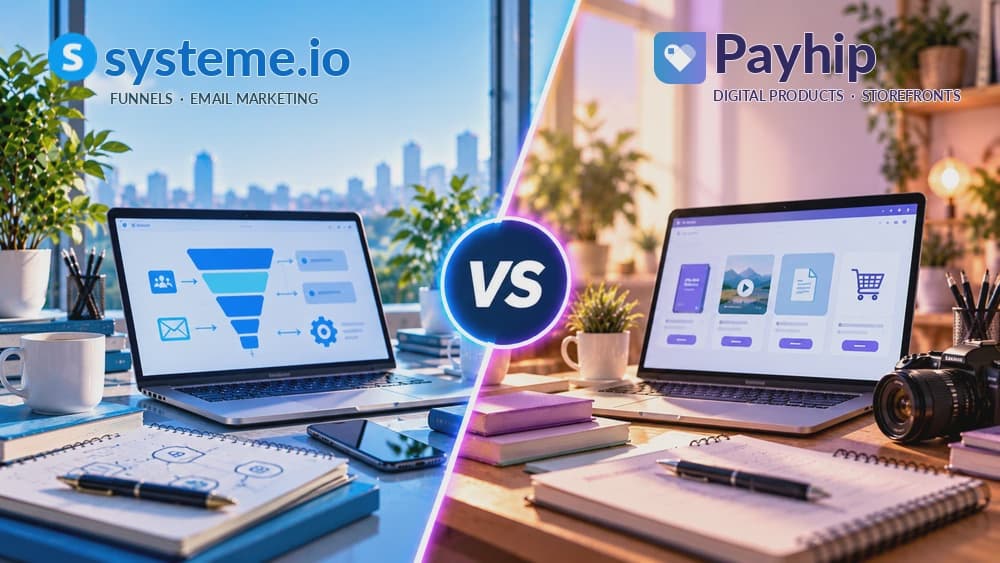
Choose from the way you acquire customers and the economics of the whole stack: Systeme.io for an integrated marketing funnel, Payhip for a focused storefront, Gumroad for simple creator sales, and Shopify or WooCommerce for broader commerce requirements.
The differences that actually change the decision.
Choose the business model before comparing feature lists
A creator selling three downloadable products through content or paid traffic needs a different system from a merchant building a large mixed catalog. Start by deciding whether your priority is a marketing funnel, a simple digital storefront, a creator checkout, a broader commerce platform or maximum self-hosted control.
This prevents a common comparison mistake: ranking every product by the total number of features even when most of those features will never affect the way you acquire customers, take payment or deliver the files you actually sell.
Systeme.io fits sellers who want the acquisition funnel and delivery in one system
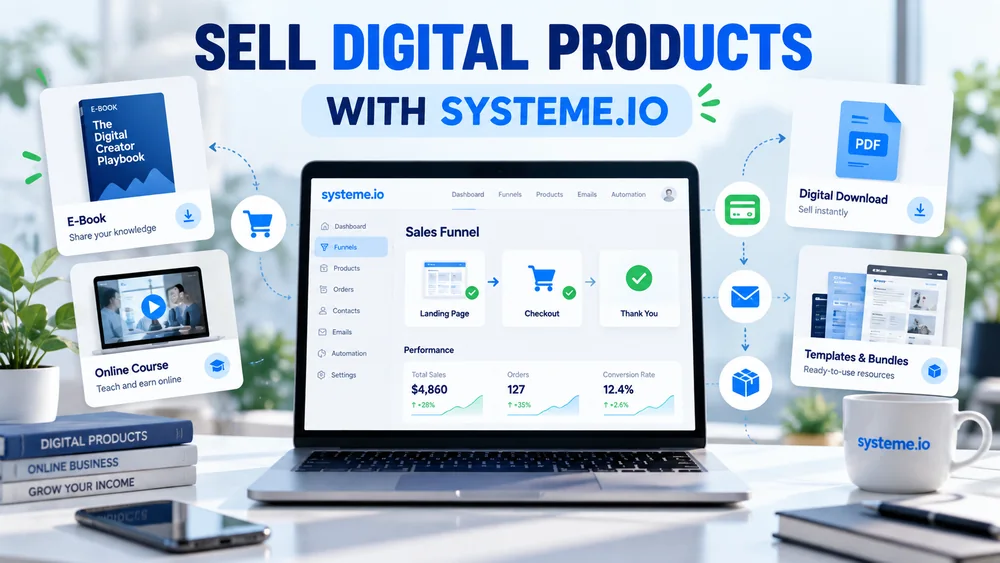
Systeme.io combines landing pages, email, automations, checkout and digital-product delivery around the same contact record. That makes it useful when the sales process starts before the checkout and includes lead capture, nurture, order bumps, upsells or other follow-up.
Its current pricing page advertises a permanent free tier and a 0% Systeme.io platform transaction fee, although the connected payment processor can still charge its own fees. The value is therefore strongest when the marketing workflow would otherwise require several subscriptions or integrations.
Payhip is a straightforward storefront with fees that fall as the monthly plan rises
Payhip currently gives every plan the same feature set and supports unlimited products and revenue. Its Free Forever plan costs $0 per month plus a 5% Payhip transaction fee, Plus costs $29 per month plus 2%, and Pro costs $99 per month with no Payhip transaction fee.
That structure is easy to understand for ebooks, templates, downloads, courses and other creator products. It is especially attractive when you want a focused selling platform and do not need the deeper funnel architecture of an all-in-one marketing suite.
Gumroad is simple for direct creator sales but the direct-sale fee is comparatively high
Gumroad remains easy to understand for creators who already have an audience and want to publish a product link quickly. Its current pricing page lists no monthly subscription and charges 10% plus $0.50 for sales through a profile or direct customer link.
Gumroad also operates a discovery marketplace, where the current fee is 30% per transaction. That can be useful when marketplace discovery creates incremental sales, but direct sellers should model the percentage fee against lower-fee storefronts or a fixed-cost system as revenue grows.
Shopify and WooCommerce make more sense when digital products are part of a broader store
Shopify is built around a full commerce store and now offers its own free Digital Products app for attaching files or links to products, tracking orders and sending customer access. That makes it a natural option when digital goods live beside a larger catalog or more sophisticated retail operations.
WooCommerce gives WordPress owners deep control over virtual and downloadable products, including file-delivery and access settings. The trade-off is operational responsibility: hosting, WordPress maintenance, extensions, security and the final checkout stack remain part of the system you manage.
Compare total economics and customer acquisition before choosing the winner
If you still need to build an audience, pages, email and automation can matter more than having the most elegant standalone checkout. If you already own the audience, transaction economics, product delivery, tax handling and storefront workflow may become more important than lead-generation features.
Model the total system rather than one headline price: monthly software, platform transaction fees, payment processing, required apps or plugins, email tooling, hosting and maintenance time. The best platform is the one that keeps the complete path profitable and understandable at your current scale.
Check these four signals.
✓The platform fits the primary acquisition model
✓Transaction and payment-processing costs are modeled separately
✓Digital delivery works without unnecessary manual steps
✓Monthly tools, apps, hosting and maintenance are included in total cost
The safest way to choose is to build a small real-world workflow.
Test the part of the customer journey that matters most before moving your entire system.
Official sources for this guide
Software pricing and features can change. Review the official documentation below before choosing a product or plan.