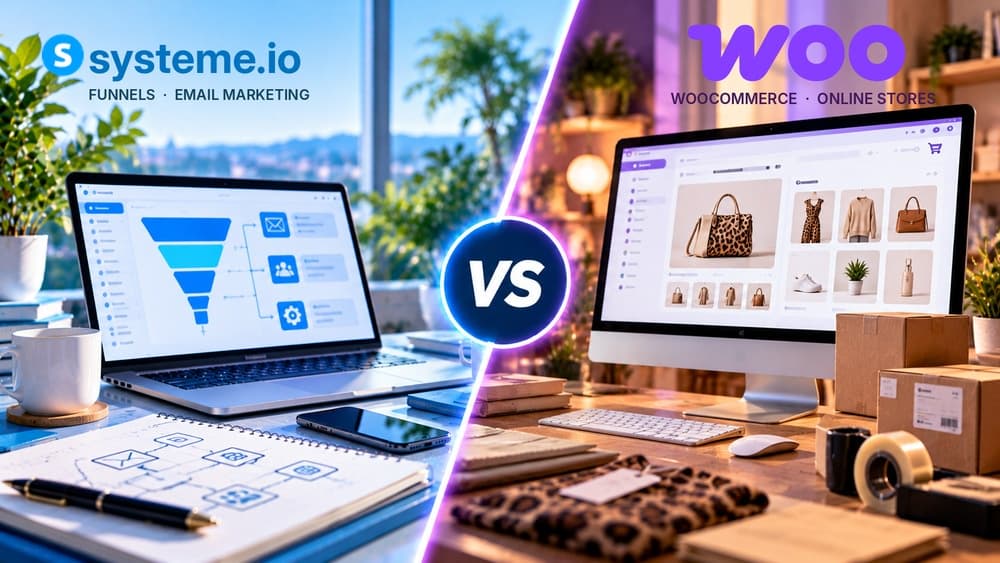
Systeme.io vs WooCommerce in 2026: Simple Funnel or Flexible WordPress Store?
WooCommerce is the stronger foundation for a deeply customizable WordPress store. Systeme.io is the simpler foundation for selling a smaller set of offers through email and funnels with less technical maintenance.
The differences that actually change the decision.
WooCommerce is an extensible store while Systeme.io is an integrated sales system
WooCommerce is the free, open-source ecommerce layer for WordPress. You choose the host, theme, payment processor, extensions and technical architecture, which gives the business substantial control over how the store evolves.
Systeme.io takes the opposite approach: fewer infrastructure decisions and more marketing functions already connected. It is built for operators who value speed and integration more than maximum store customization.
WooCommerce core is free but the complete store has variable operating costs
WooCommerce currently lists the core platform at $0 with no monthly platform subscription and 0% revenue share. Its official pricing guide estimates hosting at roughly $25 to $350 per month for most stores and extensions at about $29 to $299 per year each.
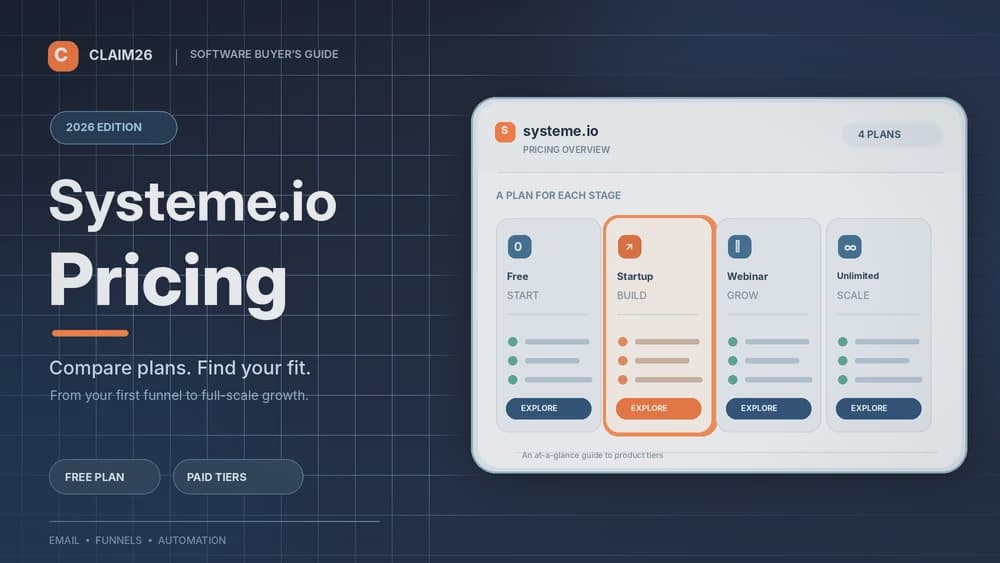
Systeme.io uses a more predictable plan model and starts with a permanent $0 Free tier. The comparison is therefore free open-source software plus chosen infrastructure versus a hosted all-in-one platform with capacity limits.
WooCommerce wins when catalog flexibility and ownership are central requirements
A large store can use WordPress themes, product variations, specialized extensions and custom development to shape almost every part of the commerce experience. That flexibility is valuable when ecommerce itself is a major technical asset.
For one flagship offer, a course, ebook or small product range sold through ads or lead nurture, that flexibility can create more maintenance than value. A simpler funnel may be enough.
Systeme.io connects marketing stages without building a WordPress integration stack
Systeme.io can connect pages, contacts, email, tags, checkout, upsells and product delivery inside one account. There is less need to select separate plugins for each stage of a basic funnel.
WooCommerce can reproduce sophisticated marketing flows, but usually through WordPress plugins, email services or custom integrations. That modularity is powerful when you want control, but it creates more components to monitor.
Maintenance is part of the real WooCommerce cost
A self-managed WordPress commerce stack involves hosting, updates, backups, extension compatibility, security and performance decisions. Businesses can outsource much of that work, but the work still exists somewhere in the operating model.
Systeme.io trades some flexibility for a managed environment. That can be a better economic choice for a small team even when the nominal software price is higher than a free open-source core.
Choose WooCommerce for a store platform and Systeme.io for a funnel platform
Choose WooCommerce when you need a serious catalog, WordPress ownership and the ability to extend ecommerce deeply over time. It is the more flexible foundation for a store-centric business.
Choose Systeme.io when the primary job is converting traffic into a limited set of offers through email and funnels with minimal technical maintenance. Compare total operating effort, not only license cost.
Build a twelve-month cost model instead of comparing free logos
WooCommerce says its core platform is free, while its official planning range for hosting is $25–$350 per month for many stores and paid extensions commonly fall between $29 and $299 each year. These are published planning ranges, not minimum charges every shop must incur. See https://woocommerce.com/pricing/. Systeme.io publishes a permanent Free tier, with paid plans that expand funnel, contact and automation capacity: https://systeme.io/pricing.
An illustrative WooCommerce budget using $25 monthly hosting and one $79 yearly extension totals $379 in the first twelve months before domain, payment fees, tax, design or maintenance. This is arithmetic using example inputs, not a quote or a claimed real customer spend. For Systeme.io, price the plan that supports your actual workflows rather than assuming Free will remain sufficient at every stage.
Separate payment processing charges from platform fees
WooCommerce advertises no platform revenue share, but card processors charge for their services. Systeme.io also advertises 0% platform transaction fees; that does not make Stripe, PayPal or other processors free. Fees depend on your country, payment method and merchant agreement, so neither platform has a universal all-in checkout cost.
Model your real average order, refund rate and payment methods before choosing. Include any subscription or specialized checkout extension needed on WordPress, and do not mistake a marketing feature advertised by a hosted platform for identical behavior to a dedicated store plugin. A realistic checkout test is more useful than comparing two zero-percent headlines.
Email marketing depends on which workflow you actually need
Systeme.io provides pages, contact tags, campaigns and automation in one environment. A WooCommerce merchant can instead connect a dedicated email provider such as MailerLite through a WordPress plugin and API token. MailerLite's official WooCommerce setup guide covers subscriber groups, product blocks and ecommerce actions: https://www.mailerlite.com/help/how-to-connect-woocommerce-to-mailerlite.
That approach allows a more modular email stack, but requires consent and integration checks. MailerLite notes that ecommerce automations need active marketing subscribers, and abandoned-cart and abandoned-checkout triggers are separate events. Sending offers to everyone who purchased is not a valid default simply because purchase data can be synchronized.
Search visibility and migration work belong in the comparison
WooCommerce sits inside WordPress, where the store owner can choose themes, URL handling, content architecture and SEO extensions. That flexibility helps when categories, complex catalogs and specialized structured data matter, but it also creates more update and compatibility work. Systeme.io offers a simpler integrated publishing and sales environment when an elaborate WordPress stack is unnecessary.
Before moving an existing store, inventory the indexed product and category URLs, metadata, canonical links, internal navigation and inbound links. Where URLs change, plan appropriate redirects and verify the sitemap and real pages after launch. A migration justified only by a lower subscription line can lose value if customers or search engines can no longer find important pages.
Use a decision checklist for the business you are actually running
For a creator selling a course or a handful of digital offers, build one real lead-to-checkout-to-delivery journey with Systeme.io and test its limits. For a catalog-heavy retailer that needs product variation rules, shipping extensions and unusual checkout requirements, WooCommerce deserves closer evaluation, provided someone can maintain its WordPress stack.
For a mixed business, list the workflows needed in the next year: product management, delivery, email consent, acquisition, reporting and payments. Mark which features are included, which require extensions and who owns security and maintenance. Choose only after accounting for those operational costs. Neither platform is automatically the best choice for every store.
Check these four signals.
✓A large or complex product catalog is central
✓WordPress ownership and extensibility are strategic
✓You want to minimize plugin and hosting maintenance
✓Your main sales motion is a limited set of funnel offers
The safest way to choose is to build a small real-world workflow.
Test the part of the customer journey that matters most before moving your entire system.
Official sources for this guide
Software pricing and features can change. Review the official documentation below before choosing a product or plan.