Systeme.io vs Webflow in 2026: Sell Faster or Build a More Custom Site?
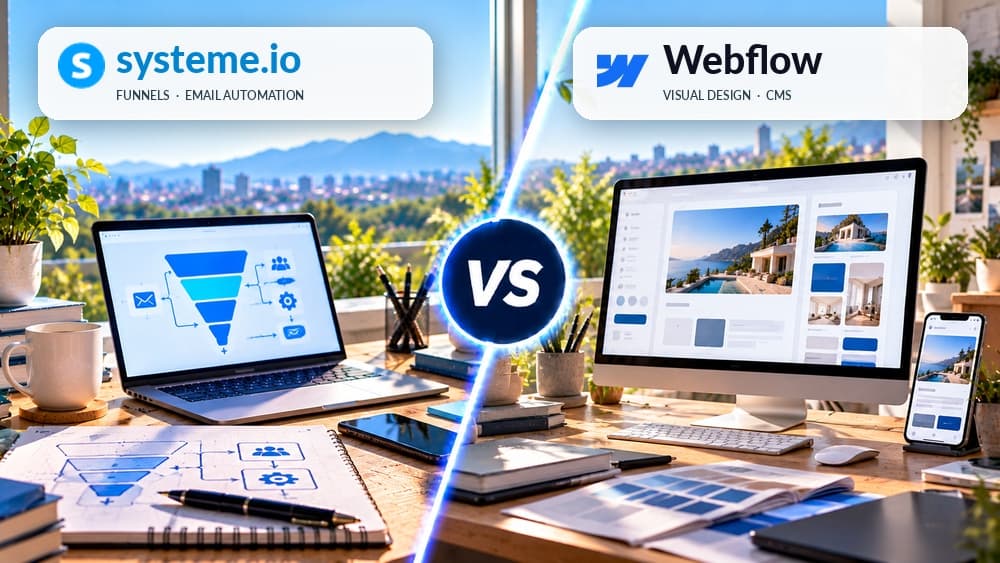
Webflow is the stronger website-design and CMS platform. Systeme.io is the more direct sales system when pages, contacts, email, automation and checkout need to work together with minimal integration overhead.
The differences that actually change the decision.
Webflow is a website platform first, while Systeme.io is a sales system first
Webflow is built for visual web creation, structured CMS content, components, hosting and a high degree of design control. Systeme.io is built to move a prospect through a commercial journey using pages, contacts, email, automation, checkout and delivery in one connected account.
The overlap can hide this fundamental difference. A brand-led website and a conversion-led funnel can both contain pages and forms, but the daily work behind them is different. Choose the platform whose default workflow matches the work you repeat most often.
Both have a free starting point, but their free plans solve different problems
Webflow currently offers a free Starter Site plan for experimenting on a Webflow subdomain. Its Basic Site plan is now $15 per month when billed yearly, while the newer Premium Site plan begins at $25 per month billed yearly for content-rich CMS needs.
Systeme.io's permanent Free plan is designed around a small working sales stack: up to 2,000 contacts, three funnels, one automation rule, one workflow and a custom domain under the current table. The better free plan depends on whether you are testing a website or a sales process.
Webflow wins clearly when design and CMS depth are competitive advantages
For agencies, design teams and content-heavy sites, Webflow offers a much deeper visual canvas and CMS model than a typical funnel builder. Complex layouts, reusable components, structured collections and design systems can justify the additional construction effort.
Systeme.io is intentionally more constrained. That can be a disadvantage for a flagship brand site, but it can also be an advantage when the goal is to publish a lead page, offer and follow-up path quickly without turning the project into a web-design exercise.
Systeme.io reduces the number of marketing connections you need to maintain
A Webflow site often relies on other products for lifecycle email, deeper funnel logic, course delivery or specialized sales automation. Those integrations can create a very capable stack, but they also create more accounts, bills and data connections to maintain.
Systeme.io brings those core commercial functions together. The trade-off is less design freedom, but a small business may value the operational simplicity more than a highly customized front end, especially while the offer is still changing frequently.
Webflow Ecommerce adds a separate cost and fee structure
Webflow currently lists Ecommerce Standard at $29 per month billed yearly with 500 ecommerce items and a 2% Webflow transaction fee in addition to payment-processing fees. Plus is $74 per month billed yearly and removes the Webflow transaction fee, while Advanced is $212.
That model can make sense for a highly customized web store integrated into a strong brand site. For a small number of digital offers sold through funnels, Systeme.io's simpler sales architecture may require less infrastructure and less ongoing design work.
Decision: optimize either the website experience or the sales workflow first
Choose Webflow when design, CMS architecture and website control are central to the competitive advantage. Choose Systeme.io when speed from visitor to lead, email, checkout and delivery matters more than maximum visual freedom.
Some mature businesses may use both, with Webflow as the public brand site and Systeme.io for specific funnels. Before adopting two platforms, verify that the additional flexibility produces enough commercial value to justify duplicated maintenance, tracking and publishing work.
Check these four signals.
✓Visual design is a major competitive advantage
✓You need a deep structured CMS
✓You want the shortest path from lead to sale
✓You can justify maintaining a separate site and funnel stack
The safest way to choose is to build a small real-world workflow.
Test the part of the customer journey that matters most before moving your entire system.
Official sources for this guide
Software pricing and features can change. Review the official documentation below before choosing a product or plan.