Systeme.io vs Substack in 2026: Paid Newsletter or Complete Sales System?
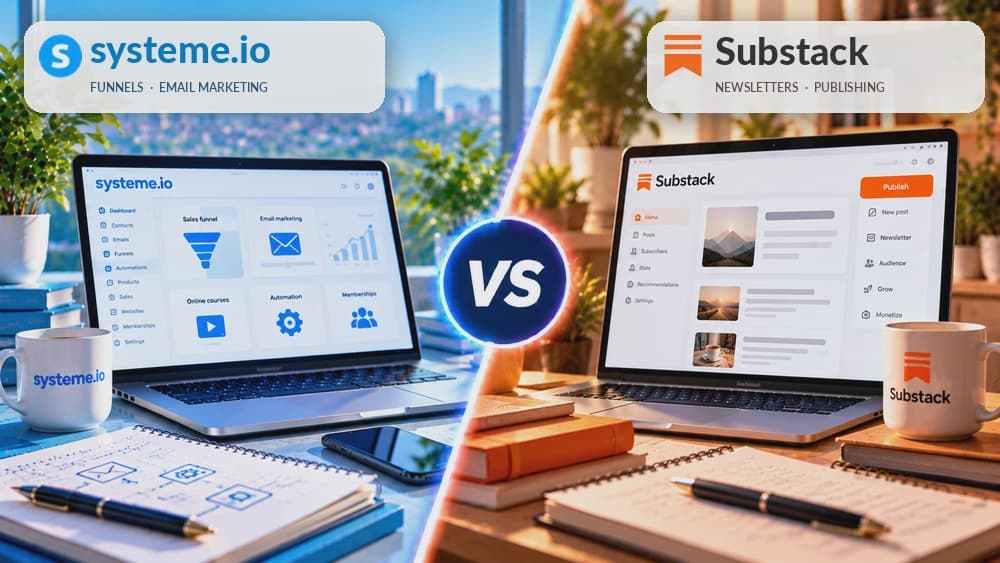
Substack is purpose-built for publishing and paid readership. Systeme.io is the better fit when email supports several offers and a broader funnel rather than being the product itself.
The differences that actually change the decision.
Substack starts with publishing while Systeme.io starts with the commercial journey
Substack combines publishing, email distribution, audience subscriptions and paid memberships in one intentionally simple product. That is powerful when the publication itself is the thing readers are paying to receive.
Systeme.io is broader: capture pages, email campaigns, funnels, checkout, courses, products and automation can all be connected. It is more suitable when a newsletter supports several offers rather than being the primary product.
Publishing on Substack is free but paid subscriptions carry a platform fee
Substack currently says publishing is free regardless of subscriber count. When paid subscriptions are enabled, Substack keeps 10% of subscription revenue, while Stripe payment-processing and billing fees are additional.
Systeme.io uses subscription-plan pricing instead and currently advertises 0% platform transaction fees across its plans, excluding the fees charged by payment processors. Revenue level therefore changes which pricing model feels cheaper.
Substack removes enormous setup work for a publication-first business
An author can publish posts, deliver them by email, manage free and paid readers and enable recurring subscriptions without constructing a conventional funnel. That simplicity is not a missing feature; it is the core reason many publishers choose the platform.
If your business model is primarily paid writing or membership around a publication, forcing a more complex marketing stack can create work without creating proportional value.
Systeme.io gives more control when one subscriber can buy several different offers
The same Systeme.io contact can move through campaigns, tags and workflows and later buy a course, ebook, coaching offer, subscription or other product. That supports a business with multiple monetization paths.
Substack can link out to external products, but its native paid model remains centered on reader subscriptions. Decide whether you are monetizing the publication itself or using content to move people toward a wider product ecosystem.
The 10% fee becomes more important as subscription revenue grows
A percentage-based model is easy to accept when revenue is small because there is little fixed cost. As recurring revenue grows, the absolute amount paid to Substack grows with it, so creators should compare that variable fee with the fixed cost and operational work of alternative stacks.
Do the calculation using your own expected paid-subscriber revenue rather than treating free publishing as the entire cost picture. Include Stripe fees in either model where payment processing applies.
Choose the business model first and the software second
Choose Substack when the central product is a publication and paid readership, and you value a low-setup writing and subscription experience. The platform's simplicity can be a conversion advantage for that exact model.
Choose Systeme.io when email is part of a broader acquisition and sales system with several offers, structured funnels and automation. If you are unsure, map the customer journey on paper before comparing feature lists.
Check these four signals.
✓Paid writing is the primary product
✓You want the lowest setup complexity for a publication
✓You sell several offer types through email
✓Percentage fees become material as recurring revenue grows
The safest way to choose is to build a small real-world workflow.
Test the part of the customer journey that matters most before moving your entire system.
Official sources for this guide
Software pricing and features can change. Review the official documentation below before choosing a product or plan.