Systeme.io vs Shopify in 2026: Sales Funnel or Full Ecommerce Store?
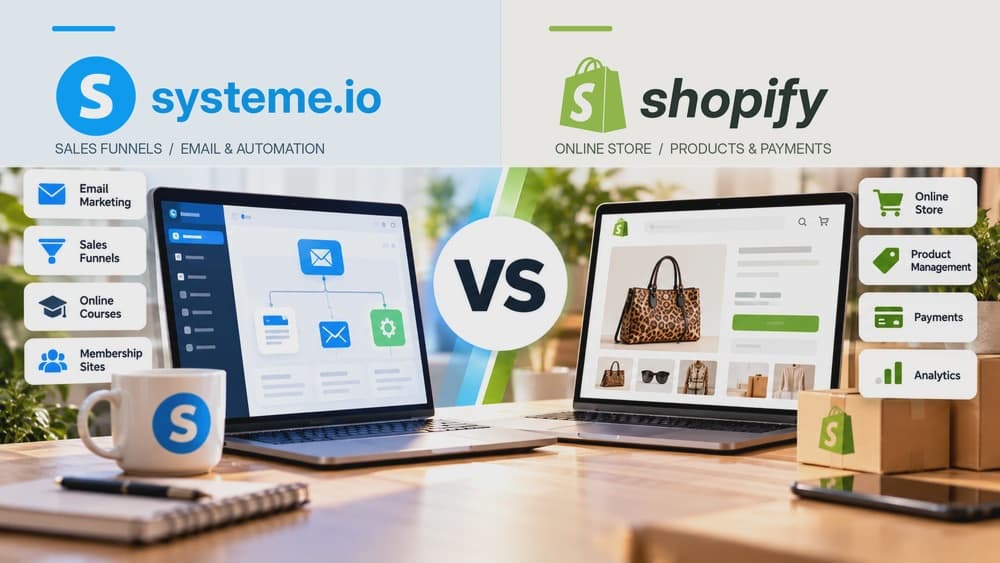
Shopify is the stronger platform for a real ecommerce operation with catalog, inventory, shipping and multichannel selling. Systeme.io is the simpler platform for guided funnels and digital offers.
The differences that actually change the decision.
Shopify is built around the store while Systeme.io is built around the funnel
Shopify provides a full online store, unlimited products, themes, checkout, inventory tools, social and marketplace selling, and a large commerce ecosystem. The product is designed for businesses where managing the store is a central daily operation.
Systeme.io is more focused on a guided journey around an offer: capture the lead, nurture the contact, present a product, take payment and automate delivery. That model is often more natural for courses, ebooks, coaching and focused digital offers.
Shopify Basic currently costs $39 monthly or $29 with annual billing
Shopify currently lists Basic at $39 per month on monthly billing and $29 per month when paid annually. Grow is $105 monthly or $79 annually, while Advanced is $399 monthly or $299 annually.
Systeme.io starts at $0 permanently and its paid tiers begin much lower. That price difference matters most when the business does not actually need Shopify's inventory, shipping and large-catalog commerce infrastructure.
Shopify is the stronger choice for catalogs, inventory and multichannel retail
Shopify supports unlimited products, inventory locations, shipping workflows, social channels and marketplace selling across its core plan family. Higher tiers add more staff and global-commerce capabilities.
A business selling dozens or hundreds of physical products needs operational commerce features that a funnel-first platform is not designed to replace. In that environment, Shopify's specialization is a strength rather than unnecessary complexity.
Systeme.io can be more efficient for one flagship offer or digital-product funnel
When most traffic should move toward one product, webinar, course or lead magnet, a controlled funnel can convert more naturally than sending every visitor into a broad catalog. Systeme.io connects that path directly to email and automation.
Shopify can also sell digital products and use landing-page applications, but the business remains organized around the store. Compare whether customers browse a catalog or follow a specific acquisition campaign before selecting the architecture.
Payment and transaction economics depend on the payment setup as well as the plan
Shopify publishes card-processing rates that vary by plan and can also apply additional transaction fees in some payment setups. These costs should be modeled using the country, payment method and sales volume of the actual store.
Systeme.io currently advertises 0% platform transaction fees, while connected payment processors still charge their own fees. For digital offers, that simpler platform-fee model can be easier to forecast.
Choose Shopify for ecommerce operations and Systeme.io for conversion-led selling
Choose Shopify when product catalog, inventory, shipping, retail channels and store operations are core to the business. Its monthly cost pays for infrastructure that a serious ecommerce operation actually uses.
Choose Systeme.io when the business sells a smaller number of offers through landing pages, email and automation and does not need a full retail operating system. Compare the customer's buying path, not simply the number of features.
Check these four signals.
✓You manage a real physical-product catalog
✓Inventory and shipping are daily operations
✓Most visitors should follow one primary funnel
✓The business sells courses, services or a small set of digital offers
The safest way to choose is to build a small real-world workflow.
Test the part of the customer journey that matters most before moving your entire system.
Official sources for this guide
Software pricing and features can change. Review the official documentation below before choosing a product or plan.