Systeme.io vs ActiveCampaign in 2026: All-in-One Selling or Advanced Marketing Automation?
ActiveCampaign is the stronger specialist for sophisticated segmentation and lifecycle automation around an established stack. Systeme.io is the simpler choice when acquisition, email, checkout and delivery should remain in one platform.
The differences that actually change the decision.
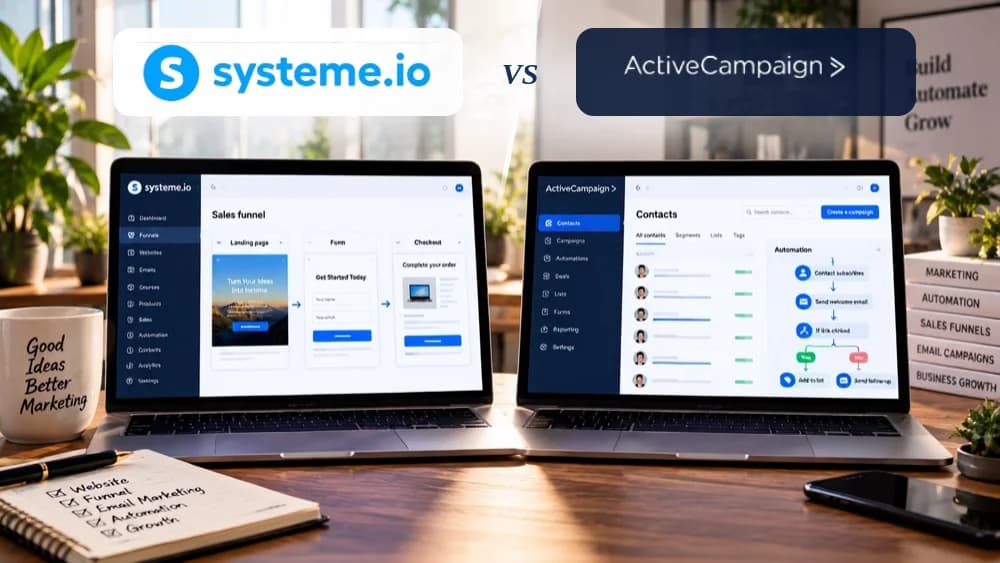
ActiveCampaign is an automation platform first while Systeme.io is a selling platform first
ActiveCampaign centers its current product around email marketing, segmentation, multi-step automation, ecommerce and CRM integrations, landing pages and AI-assisted marketing. Higher tiers add more sophisticated segmentation and predictive capabilities.
Systeme.io also automates customer journeys, but the workflow is more directly tied to its own funnels, checkout, courses and digital products. That makes it simpler when the marketing and selling stack can remain inside one product.
ActiveCampaign pricing is contact-based and should be calculated from your real list size
ActiveCampaign's pricing interface currently asks for the primary marketing channel, contact volume and plan before producing the relevant price. Its published plan family includes Starter, Plus, Professional and Enterprise. Starter is restricted to five actions per automation, whereas the higher levels provide more advanced features. Check the precise tier, contact volume and modules: https://help.activecampaign.com/hc/fr-fr/articles/14251311251356-Pr%C3%A9sentation-des-offres-ActiveCampaign.
Systeme.io uses a permanent Free plan followed by fixed platform tiers with contact and resource allowances. That structure is easier to estimate for a small business, while ActiveCampaign becomes more appropriate when deeper automation creates measurable value.
Segmentation and multi-step automation are stronger reasons to choose ActiveCampaign
ActiveCampaign's current plans emphasize marketing automation, segmentation, ecommerce and CRM integrations, conditional content, attribution and predictive capabilities as the tiers increase. Those features suit teams managing more sophisticated lifecycle marketing.
Systeme.io can automate common paths effectively, but it is intentionally simpler. If the customer journey requires complex behavioral branching across a larger stack, ActiveCampaign's specialist depth can outweigh the additional software cost and integration work.
Systeme.io has a major advantage when the sale and delivery also need to be native
A Systeme.io funnel can capture the lead, send email, take payment, apply tags and grant course or product access without handing the contact to a separate checkout or delivery platform for the core journey.
ActiveCampaign integrates with ecommerce and CRM systems rather than trying to be every part of the commerce stack itself. This is powerful for businesses that already have a chosen store or CRM and want a dedicated automation layer around it.
The right architecture depends on whether specialization or consolidation matters more
A mature company may prefer specialist systems for commerce, CRM and marketing automation because each can be optimized independently. ActiveCampaign fits naturally into that architecture when sophisticated orchestration is strategically important.
A creator or small team may get more value from consolidating pages, email, checkout and delivery. Systeme.io reduces the number of integrations that need to be maintained before the business has the volume to justify a more modular stack.
Choose ActiveCampaign for automation depth and Systeme.io for operational simplicity
Choose ActiveCampaign when complex segmentation, lifecycle automation and integrations with an established CRM or ecommerce stack are core requirements. Calculate the plan using the contact volume you actually expect to manage.
Choose Systeme.io when the main goal is to launch and sell through one integrated environment with lower fixed complexity. Upgrade the architecture only when a specific automation requirement proves that the simpler system is no longer enough.
Check these four signals.
✓Complex lifecycle automation is already a requirement
✓You have an established CRM or ecommerce stack to orchestrate
✓You want to consolidate checkout and delivery with marketing
✓Pricing needs to remain predictable while the business is small
The safest way to choose is to build a small real-world workflow.
Test the part of the customer journey that matters most before moving your entire system.
Official sources for this guide
Software pricing and features can change. Review the official documentation below before choosing a product or plan.