Systeme.io CRM in 2026: Contacts, Tags and Automation Explained
Systeme.io CRM works best as the contact layer around funnels, email and purchases. Tags and automation can organize simple customer journeys, while complex B2B pipelines remain a stronger fit for a specialist CRM.
The CRM is designed around marketing contacts rather than a complex sales pipeline
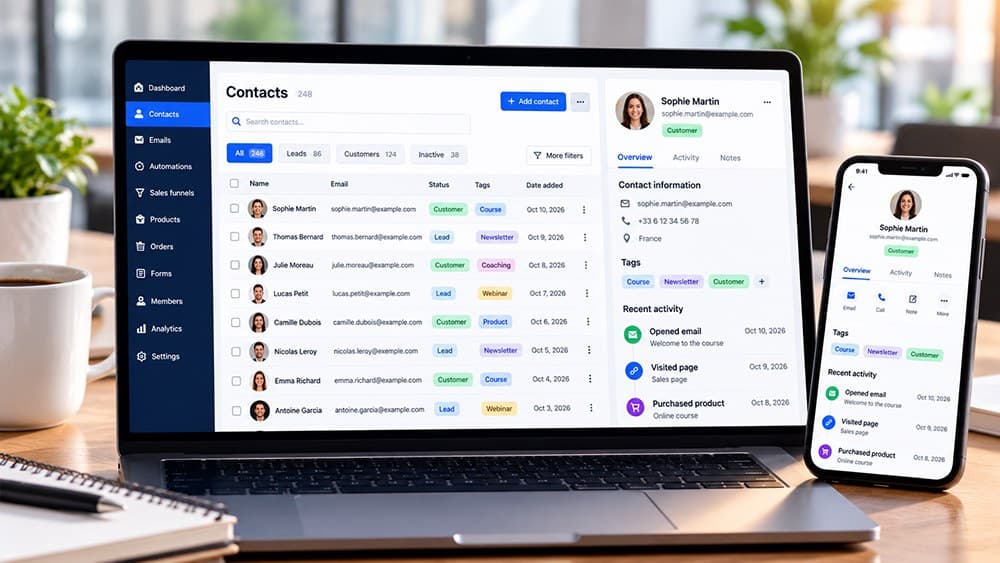
Systeme.io stores leads, customers and students in the CRM so the same contact can be connected to forms, campaigns, purchases and access to digital content. This is useful when the main goal is following a person through an online sales journey.
It is not trying to reproduce every function of a specialist enterprise sales CRM. If your team needs complex deal stages, forecasting, territory management or extensive sales reporting, the contact database may need to be complemented by a more specialized system.
Tags are the simplest way to organize contacts by source, status or interest
Systeme.io's current help documentation describes tags as a core way to classify contacts and target newsletters. A tag can represent where the lead came from, what they bought, which topic interests them or another status that changes how you communicate.
Keep the naming system predictable from the beginning. A small set of useful tags is easier to maintain than dozens of nearly identical labels that make later segmentation and automation harder to understand.
Tags can be added manually or triggered automatically by customer actions
Contacts can receive tags manually from the CRM, through payment-page resources or automatically through automation rules. This lets the database update itself as people subscribe, buy or move through defined parts of the funnel.
Before changing tags in bulk, check which automation rules listen for those tags. Systeme.io warns that assigning a tag can itself trigger actions such as campaign subscriptions or emails, so a seemingly simple CRM change can start a larger workflow.
Use segmentation only when it changes the message or the next action
Segmentation is valuable when two groups should receive different communication, offers or operational treatment. Examples include prospects versus customers, buyers of different products or contacts acquired from different campaigns.
Avoid collecting labels and custom information without a downstream use. Every segment should answer a practical question: who needs this message, who should enter this workflow or which contacts should be excluded from an action.
Test CRM automation from the contact record to the final outcome
Create a test contact, apply the same tag or trigger a real form action, then inspect the resulting contact record and automation behavior. Confirm that the campaign, email or workflow starts exactly once and that the contact remains in the expected segment afterward.
This end-to-end test is especially important when several tags trigger different automations. A clear test contact makes it easier to identify whether the problem sits in the form, tag logic, trigger or downstream workflow.
Move to a specialist CRM only when the sales process itself becomes the bottleneck
For creators, small online businesses and simple service sales, Systeme.io's contact-centered CRM can be enough because marketing and selling happen in the same platform. Fewer systems also means less synchronization work.
A dedicated CRM becomes more relevant when a sales team needs opportunity pipelines, deal ownership, forecasting, advanced scoring or structured B2B processes. Upgrade because the sales process requires it, not because the word CRM appears on a longer software checklist.
Check these four signals.
✓Contacts need to share data with funnels and email
✓Tags have clear source, status or interest meanings
✓Automation triggers are tested before bulk tag changes
✓A specialist pipeline is added only when sales operations require it
Need the bigger picture before choosing a plan?
Open the current offer and check Systeme.io pricing, limits and features before deciding on a subscription.
Official sources for this guide
Software pricing and features can change. Review the official documentation below before choosing a product or plan.